
May 2022
the pigs
Vacation: a period of leisure and recreation when one often experiences things that one doesn’t ordinarily experience when engaged in normal, everyday non-vacation activities.
For instance, when I go about my house, my work, running errands, chatting with my neighbors — what am I talking about? I never chat with my neighbors — anyway, I never see sus scrofa. In fact, in my life I have only seen sus scrofa twice, once in Florida while on vacation and once somewhere else, possibly in a dream.
Sus scrofa. The feral hog. In Congaree National Park, South Carolina, sus scrofa is a berserker, wildly disrupting natural food chains, damaging natural habitats, reducing tourism (they can be scary) and possibly carrying diseases.
The National Park Service decided that they needed to cull the herd at Congaree. So they shot them. Hundreds of pigs over the years, including the day we visited.
Kenn: I wonder why they are closing the Park at 4 p.m.
Lisa: Because that’s when they start shooting the pigs.
not a marsh
Congaree National Park. It’s largely a swamp, low-lying, uncultivated ground mostly covered with water, a forested wetland. The water may be fresh, brackish (a combination of river water and seawater) or straight up seawater.
This is our first time in this national park. We learn that Congaree claims some impressive residents. Giant hardwoods live here, along with startlingly tall pine trees. Congaree claims 512 wetland plants, 328 terrestrial plants, 33 amphibians, 75 reptiles, 71 fish, 200 species of birds and 37 mammals, not including tourists. Also butterflies.
Areas somewhat like this may be labeled “wetland,” “marsh,” “floodplain” or “waterway.” Congaree is none of these. It’s a swamp. You may want a card with this explanation printed on it for your wallet, in case you need it.
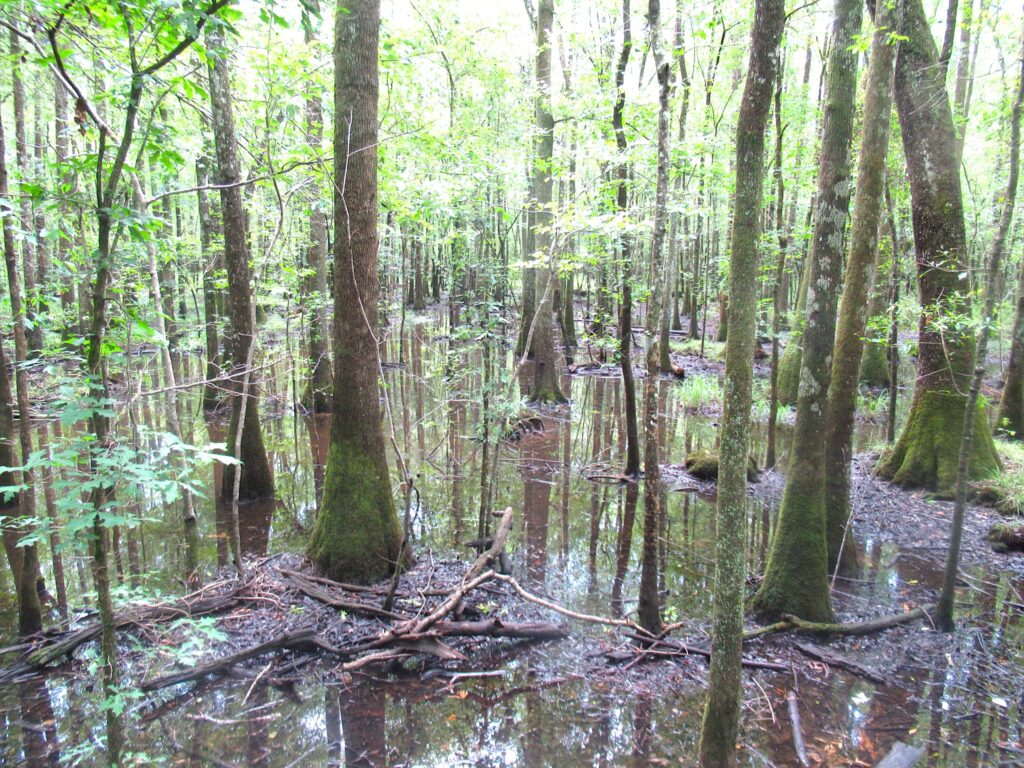
who lives here?
Most of us relate better to animals than to other species. Our animal list at Congaree is long. Take a deep breath and… go!
Cat, elk, deer, horse, wolf, bat, opossum, armadillo, alligator, pika, rabbit, weasel, snake, badger, otter, mink, wolverine, mole, solenodon (like a shrew,) shrew, bear, dog, raccoon, sea lion, skunk, ferret. Oh yeah, a few random sus scrofa.
To attempt to spot any of these species, Lisa and I hung out on a wooden observation deck, just quietly observing. This is where we had our most curious and mildly bizarre experience of the trip. As we watched for any spotted alligator, snake or even sus scrofa, a woman I had never met spoke to me. “You have a remarkable nose, remarkable and attractive.”
Why, thank you. Probably.
Springer Mountain
Lisa and I like the Appalachian Trail. We like the idea of it, we like its accessibility, we like the terrain and we like that it’s not inside a building somewhere. We walk on it whenever we can. So while we are in the neighborhood, we choose to go hike the southern terminus
The Appalachian National Scenic Trail is 2100 miles long, give or take a few footsteps, and it is anchored on Springer Mountain among the peaks and sparkling waters of northern Georgia. Springer is in the Chattahoochee National Forest, part of the Blue Ridge Mountains which stretch from Georgia through seven states before finishing up in southern Pennsylvania. The Blue Ridge Mountains is in turn part of the Appalachian Mountain Range. Here we are.
The Appalachians can be found as a continuous geologic feature running from southeastern Canada to central Alabama. Three state high points lie in this range: Mount Katahdin (Maine,) Mount Washington (New Hampshire) and Clingmans Dome (Tennessee.)
Some people actually choose to hike the Appalachian Trail, and by hike the Appalachian Trail, I mean the whole damned trail, from one end to the other, 2100 miles linear. Depending on how long you have, takes four to seven months.
We want to visit the place where many thru-hikers first embark on their half-year journey. But here’s the kicker; you can’t drive to the southern terminus. To get there, most hikers begin at Amicalola Falls State Park. Passing through the stone arch, one hikes seven miles uphill just to get to trailhead.
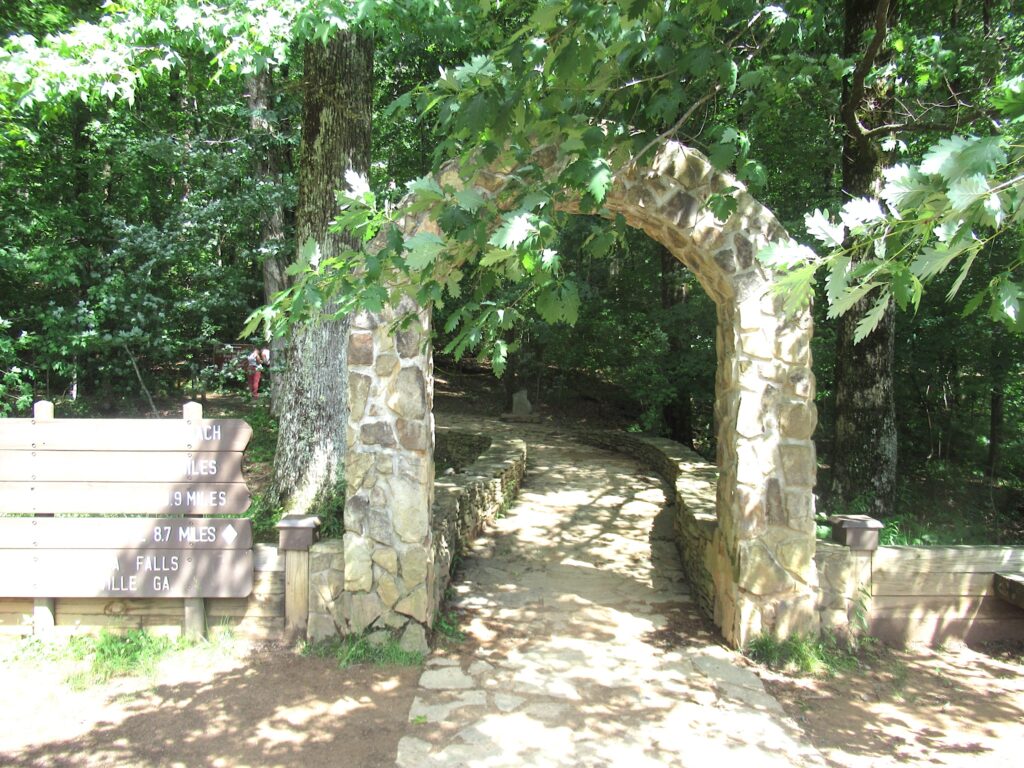
But wait, there is a road to a parking lot much closer to the official terminus of the A T. The trail runs right past the western edge of this lot.
For this trip, we choose to leave our vehicle at this A T parking lot on Springer Mountain and to hike to the terminus over flat terrain. Flat, but made of dirt, rocks, roots and drainage. Gotta keep an eye on footfall. Driving up to the parking lot is very much more of a challenge. Even though we are sitting down for the whole drive, the road is barely vehicle-worthy, as rooted and rutted as a passable road can be. We didn’t drive up so much as bounce up. I can safely say this is the second worst road I’ve ever been on. But that doesn’t stop Lisa. When she drives, yer gonna get there. Which we did.
From the overcrowded parking lot — we landed the last remaining parking space — it is just a few footsteps shy of a mile to the first blaze of the famed Appalachian National Scenic Trail. Gorgeous, lush forested area, lots of hikers, like us, wanting to score this particular part of the great trail.
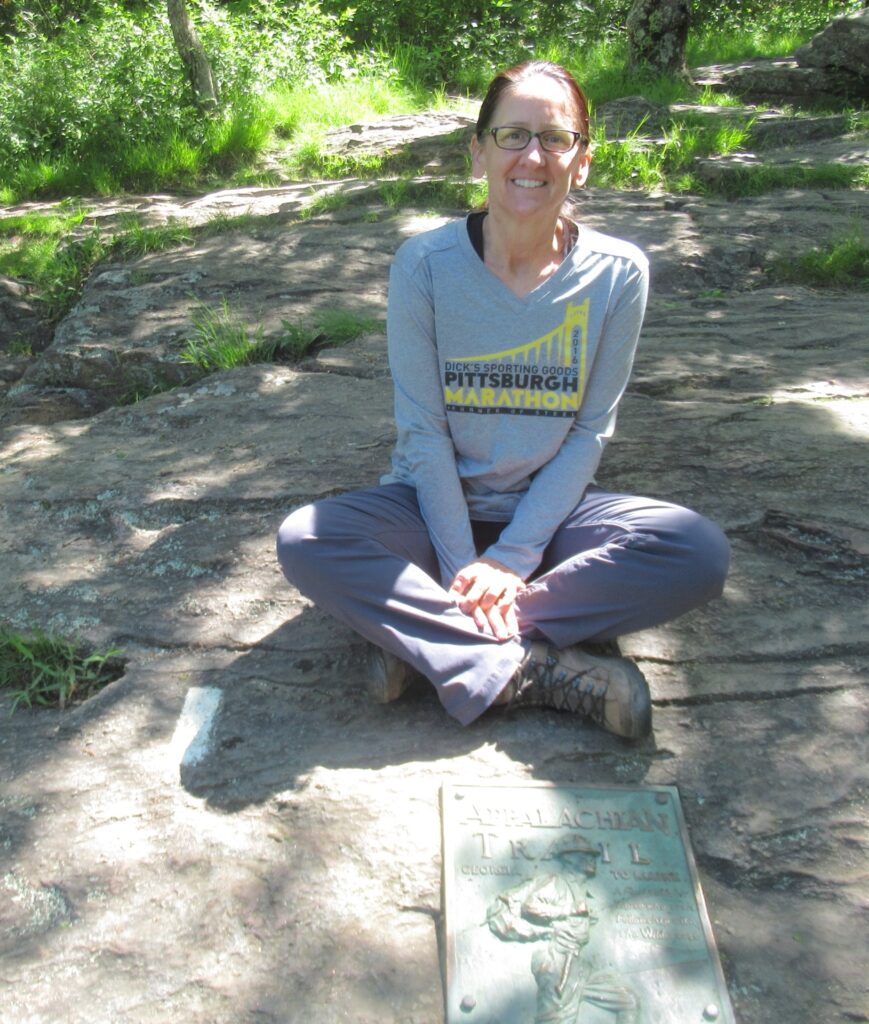
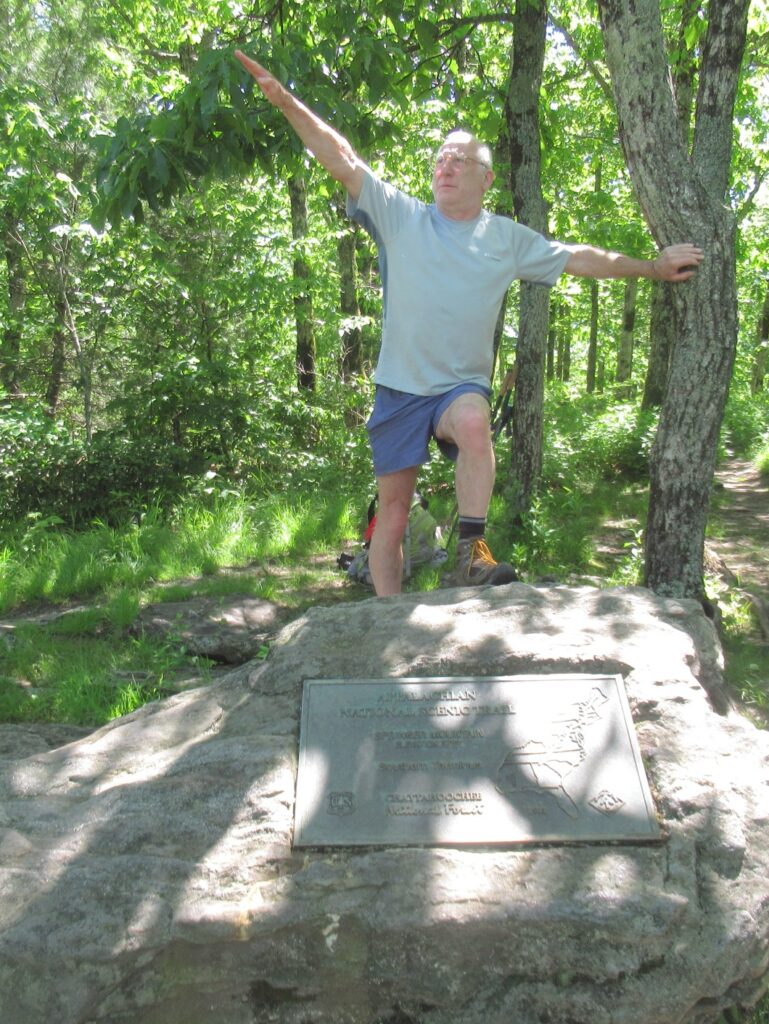
And score we do. A wonderful hike out to the terminus and back. But we need more so we hike in the opposite direction until we cross another famed footpath, the Benton MacKaye Trail, and have our lunch at a lovely stream.
Benton MacKaye was an advocate of preserving land for recreation and conservation. He had this whacky idea of balancing human needs with those of nature. He is the guy who first proposed this long trail we now call the Appalachian National Scenic Trail. That’s a big deal.
Sasquatch
Back to the car, drive down the treacherous road to the main highway by the entrance to Amicalola Falls State Park. Half an hour up the road, just past The Pink Pig B-B-Q, is the unincorporated community of Cherry Log, Georgia, population 99. You can enjoy a waterfall in Cherry Log, a lake for fishing and recreation, a 14.5-mile hiking trail and barbecue at the Pink Pig. None of these are what brought us in.
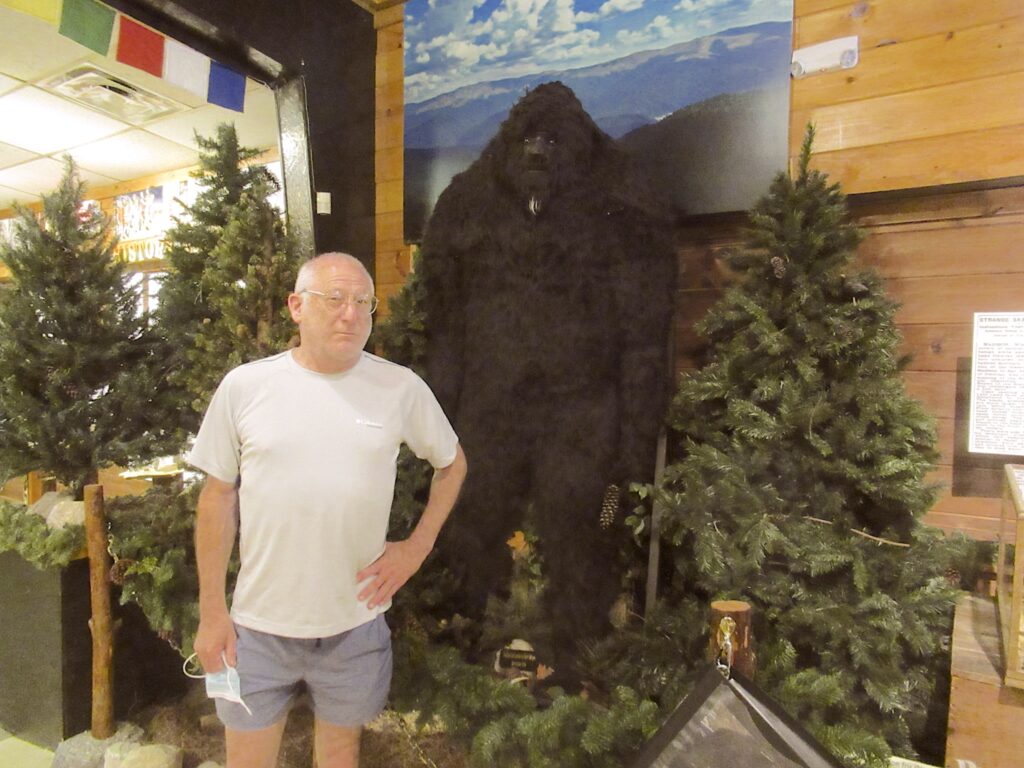
In 2016, Bigfoot researchers David and Melinda Bakara opened the “world’s largest permanent display of genuine Sasquatch artifacts.” This is what attracts us. We wander around the 4000 square foot museum, looking at the artifacts, watching the people.
Bigfoot. According to the stickers on one wall, this museum is dedicated to Bigfoot, regardless of what you call him: Devil Monkey, Skunk Ape, Big Muddy Monster, Opie, White Thang, Mogollon Monster, Wooly Booger, Mo-Mo and Boojum. But a keen eye will also see, amidst all these names, a sticker labeled “Women” and one labeled “Men.” I believe these labels refer to us humans as, simply, you don’t tell Bigfoot where to pee. I follow the “Men” sign. Also, there is a thermostat.
I’m not saying I believe, I’m not saying I disbelieve. These people? Our fellow tourists? Some of them are far more fervent than I. Try this on: They believe in the existence of Bigfoot but they do not believe in COVID. Just sayin’.
I believe the Bakaras are serious. “We are more than a museum, we are also a research and reporting center.
“If you have had an encounter that you would like to share…” contact the museum and add to the evidence.”
What’s in the museum? A Sasquatch Theater, a Bigfoot reference library with “documented sightings,” sketches, molded casts of gargantuan handprints, footprints and a cast of something you definitely don’t see every day. Displayed regally on a bed of a red velvet, a Bigfoot butt-print. A Bigfoot butt-print!
“We at Expedition Bigfoot believe in the existence of Bigfoot/Sasquatch either from personal experience and encounters or from witness testimony and evidence. Our museum provides a lot of that evidence, and leaves the question of Bigfoot’s existence up to you.
“So whether you’re a skeptic, believer or ‘knower’, all are welcome.”
the cemetery
I can’t tell you where we were other than a two-lane somewhere in Virginia. We drive past a cemetery near a lake, very pretty area. I can’t help but notice that there is an entrance and an exit to the cemetery. I think, “It’s a cemetery. What do we need an exit for?”