
everywhere, now and always
Little Red Riding Hood is making her way along an old logging road on a backpack trip when she sees a big bad wolf crouched down behind a log. “My, what big eyes you have, Mr. Wolf,” she proclaims. The wolf jumps up and runs away.
Further down the road Little Red Riding Hood sees the wolf again and this time he is crouched behind a thick bush. “My, what big ears you have, Mr. Wolf.” Again the wolf jumps up and runs away.
Two more miles down the trail Red sees the wolf yet one more time. This time he is crouched down behind a rock. With great enthusiasm, she exclaims, “My, what big teeth you have, Mr. Wolf.”
With that the wolf jumps up and screams, “Will you knock it off! Give a guy some privacy. I’m trying to poop!”
Founded in San Francisco in 1981, an a cappella vocal group, self-described as a “band without instruments” began to perform their irreverent humor, complex vocal arrangements, original compositions and inventive covers. They called themselves The Bobs.
At the time of their formation, the best way to get information about the band’s schedule was to call an 800 number on the old standard telephone thing. The band tried to get the number 1 800 THE BOBS, but somehow, it had already been taken. They settled on 1 800 THE POOP.
Not one of the band members was named Bob.
Okay people. Spend some time in the woods and this topic will become important. The need to perform this act outside of a “bathroom” may keep some people away from the wonderful world we call the Wilderness. Worse, lack of knowledge and awareness of performing this act outside of a “bathroom” may make people very ill, and could screw up the wilds we love so much. To wit…
Do you eat? Do you poop? Why is it so easy to talk about one and so embarrassing to talk about the other? I mean, heck, if you do one, you simply must do the other. Fact of life. Since we must do the other, we must talk about doing the other. I mean, imagine what the world would be like had Thomas Crapper been too embarrassed to consider the other, keeping him from inventing the flush toilet!
Now, we will talk about how to do the other and why we do the other the way we do. Do be do.
When you are at home, or in a restaurant or office building, you can go to a dedicated room, sit down on a special piece of furniture and poop. You clean up a little, trip a handle or push a button and — whoopee! — the poop goes away, disappears forever. Magic. Gone before you even stop thinking about it, and you didn’t think about it for very long.
In the city, we sit and then the poop goes away. In the woods, we sit and then we go away. More magic.
Hmmph. If you pause for a moment, you as a grown-up adult person know doggone well that, while it appears to be magic, it isn’t. Your… product… goes somewhere after you’ve deposited it in your commode, and it ain’t heaven. You know, or you may have a dim notion as a grown-up adult person, that it goes to a treatment plant which cost many millions of dollars to plan and build and many millions more to operate. If it didn’t, we would have poisoned ourselves with our own shit many years ago. In fact, one of the prime causes of the great plagues which have visited us humans over the centuries has been poor sanitation. Shit piles high enough, we get sick, we die. Bad system.
In the Wilderness, the only mechanism to remove feces that resembles a fast acting, water-based transportation network is our river and stream system. Take a crap in your bathroom and the water system in your home takes it away. Take a crap in the stream and that cute little log-shaped boat just happily floats away. Magic.
But…
When late in the afternoon I finally stumbled — sun-dazed, blear-eyed, parched as an old bacon rind — upon that blue stream which flows like a miraculous mirage down the floor of the canyon, I was too exhausted to pause and drink soberly from the bank. Dreamily, deliriously, I waded into the waist-deep water and fell on my face. Like a sponge I soaked up moisture through every pore, letting the current bear me along beneath a canopy of overhanging willow trees. I had no fear of drowning in the water — I intended to drink it all.
from Desert Solitaire by Edward Abbey, 1968
Whoa! Not so fast, Cactus Ed. You might have been able to get away with that kind of indulgence in 1968, but just try that now… Well, no. Don’t try it now.
Why? Bad bugs, that’s why. In the old days, we might have had to dodge a floating Baby Ruth, which would have been our biggest worry. But times have changed considerably in the last five decades. We now have bugs, bugs, bad bugs.
Bugs? Bad bugs? Do the names giardiasis, cryptosporidium, enteric pathogens or schistosomiasis ring a bell? If you are in 1968, go ahead and splash around and drink all you want like Mr Abbey did. The first documented case of water borne giardia lamblia was reported in 1970. Giardiasis, which you can get by ingesting cysts of giardia lamblia, is a hellishly annoying intestinal disease which, as my brother the doctor once said, “It won’t kill you, but you will wish you were dead.” A friend of mine who contracted giardiasis one spring told me she “spent the entire summer in the bathroom.” Suffice it to say that just reviewing the list of specific intestinal nasties which can befall the victim of giardiasis would be enough to make you sick. Cryptosporidium, another protozoan like giardia lamblia, can be just as nasty. Schistosomiasis is caused by a blood fluke and you don’t even want to ask about these symptoms. Just the name can make you feel like you need to purge your entire digestive system.
Not scared away, you ask, “What are these unmentionable symptoms? Maybe you would mention them.”
Behold…
Watery foul-smelling diarrhea, soft, greasy stools, fatigue, abdominal cramping, bloating, belches that leave a yucky taste, nausea and vomiting, weight loss, dehydration, hives, itchy skin, swelling of the eyes and joints.
Grossed out yet? Take heart. While these parasites seem to be gaining in their extent, we are sort-of keeping pace, at least in terms of finding ways of protecting ourselves. For one, don’t drink right out of the stream. Avoid the chance of becoming infested at the source.
If you are out in the wilderness long enough though, you will not be able to bring all the water you’ll need with you. Local water sources — streams, rivers, puddles — will be your supply. You’ll filter out the bad bugs or boil the water which kills everything that was living there, rendering it safe to consume.
Just as important in halting the intake of these various biological cooties, you must shit in the woods. No latrine? Well then, shit in the woods as the bears do. But just shitting in the woods isn’t enough. You’ve got to shit in the woods with style and reverence. Instructions can be found in Deuteronomy 23:12 and 23:13…
Thou shalt have a place without the camp, where thou shalt go forth abroad: And thou shalt have a paddle upon thy weapon: and it shall be when thou shalt ease thyself abroad, thou shalt dig therewith, and thou shalt turn back, and cover that which cometh from thee.
Exactly what shalt thou do in plain English? Simple. Don’t actually shit like a bear, but rather, shit like a cat. If you are a cat owner, you know exactly what I am talking about. For those of you who do not have the pleasure of frequently cleaning a litter box, here is what a cat does: Wait until ten minutes after your human brings his date into the home. Climb into your litter box and dig a hole. Poop into the hole and (here comes the really important part) cover it over with the litter. Cover it over so that it can’t be detected by sight or smell. Unless you have a grudge against the guest.
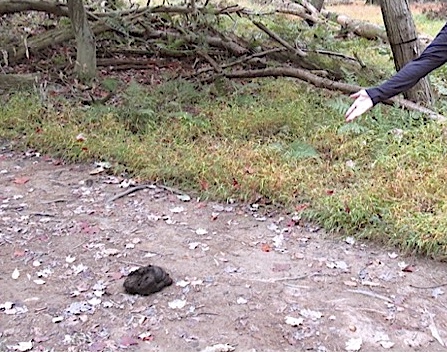
What you do in the woods is essentially the same thing. Get thee far from camp or trail or a water source, at least 200 feet (about a two or three minute walk) and dig thee a hole. Poop thee into the hole, as described in Aesop’s Fables, “thre grete toordes.” Cover it up so that it can’t be detected by sight or smell.
Your hole should be about six inches deep. In fact, several trail equipment manufacturers have etched the sides of their plastic hole-digging trowel with inch marks. This depth is essential as the layer of soil which contains the bacteria which works best to decompose the waste is down from the surface about half a foot.
Oh yeah, you’ve noticed. We use toilet paper and cats don’t. Well actually, some of us use toilet paper and some of us use leaves or rocks or ferns or snow. Whatever, you will probably use something. But once you use it, what do you do with it? Purists pack toilet paper out. Doesn’t sound very pure, does it? And if you do pack it out, you might as well pack out the poop with the paper. Purists will do that too. Some wilderness areas require it. I recommend that you triple bag the load and seal it well. Really, really well. Obsessively well. There are special kits called WAG bags for such a purpose. We’ll deal with them in another column.
If your heart is in the right place but you just can’t stand the idea of carrying with you what you least want to carry with you, you’ll need to bury the load. Also burn the paper and bury the ashes. Natural wipes such as leaves and ferns, can be buried under a thin layer of soil.
The first time you do as the bears do, you will probably feel awkward, embarrassed and surprised. Shit sometimes stinks more than you realize, depending on what you ate for dinner. You will yearn for a civilized crapper. The learning curve is steep but gentle. After the second or third time you make an outdoor latrine, it will seem like second nature.
Why ever do we go through all this business? If you simply pooped on the ground and left your trophy sitting there proudly, and no one ever came along again — no humans, no animals, no insects — and if it never rained, there would likely be no problem. But that’s not life on this Earth. Feces is a wonderful thing on which to harbor living, thriving colonies of bacteria. Bad bacteria. Turds in the woods are like magnetic toys to animals such as beaver, bear, squirrel, mouse, chipmunk and even young children. Put any of these elements together with your offering and you have the optimum transport system to spread bacteria around the woods, into the water and to other animals.
Why is this a problem now when it wasn’t for thousands of years? Simple. It was a problem. Does the black death sound familiar? Does the word plague ring a bell? The average life expectancy in those days involved regular dying by the age of 30.
It is now becoming a problem in our wilderness areas because, like in the growing towns of old, we have a great number of users. Poor sanitary practices caused disease in the populated areas because of the sheer volume of pathogens, just the very ones we can find in piles of feces. Now, we are flocking to the woods like animals and we are shitting a proportionately increasing amount. If we aren’t careful with our style and habits of elimination in the wilderness, we will turn the whole place into a toilet. I mean, who needs this shit?!
Earlier, I mentioned Thomas Crapper and his invention of the flush toilet. Pretty cool, huh. Crapper invented the crapper.
It’s a lie, a commonly believed myth. The first modern flushable toilet was described by Englishman Sir John Harington in 1596. The first patent for a flush toilet was granted to another Englishman, Alexander Cumming in 1775. Thomas Crapper, a plumber and inventor, wasn’t born until 1836.
What did he invent? Crapper held nine patents, three of them for water closet improvements such as the floating ballcock and an improvement of the S-bend plumbing trap. He had a hand in the U-bend concept too.
However, it is likely that when some American servicemen during the first World War saw the name Crapper on the water closet manufactured by the Thomas Crapper and Company company, they began to say things like, “I need to use the crapper.” And thus we have the connection between the name and the act.
Don’t believe all the crap you read.
There is a Yiddish phrase: Gay kaken afn yam. It means “go jump in the lake,”” or “stop bothering me.” While literal, it is often used colloquially to dismiss a pestering person. And now, go shit in the woods.